First published by The Patent Lawyer.
By: Shrawan Chopra and Achyut Tewari
Shrawan Chopra and Achyut Tewari of Anand and Anand examine India’s 2025 CRI Guidelines, which consolidate the law on patent eligibility for computer-related and AI inventions. They caution, however, that the Guidelines do not align Indian practice with the UK or European approaches, and that their true impact will depend on how examiners apply them and how the courts respond to the first appeals under the new framework.
“For AI filings, this is now the main prosecution risk in India, and it is made worse by a tension built into the subject matter.”
Within seven months, two common-law patent systems approached the same problem from opposite ends. On July 29, 2025, the Office of the Controller General of Patents, Designs and Trade Marks issued revised Guidelines for Examination of Computer Related Inventions, replacing the 2017 guidance and settling on “technical effect” as the test by which a computer implemented invention escapes Section 3(k) of the Patents Act, 1970.1 Then, on February 11, 2026, the UK Supreme Court in Emotional Perception AI Ltd v. Comptroller General of Patents discarded the four step test in Aerotel, which had governed UK practice since 2006, and brought the UK into line with the European Patent Office. Under Aerotel, the examiner construed the claim, identified the actual contribution, asked whether that contribution fell solely within excluded subject matter, and checked whether it was technical in nature. The inquiry thus turned on what the inventor had really added to human knowledge, assessed at the eligibility stage itself.
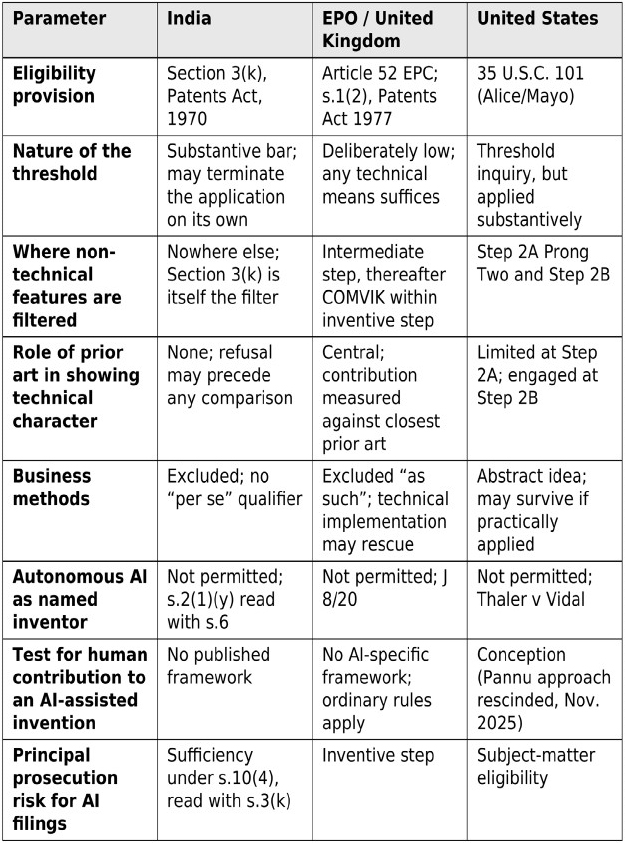
Read together, these developments suggest convergence, and an applicant filing artificial intelligence (AI) applications in all three jurisdictions might reasonably assume that the same analysis applies in each jurisdiction. It does not. The three systems use similar language but arrange the inquiry differently, and in AI applications, that difference determines the stage at which the application is won or lost.
The Guidelines and what they settle
The Guidelines are administrative instruments, not delegated legislation, and the Office has recorded that if they conflict with the Act or the Patents Rules, 2003, the statute prevails. Their value lies in consolidation rather than innovation. Section 3(k) excludes “a mathematical or business method or a computer programme per se or algorithms”, and it is worth noting that the qualifier “per se” attaches only to computer programs; a drafting choice whose consequences applicants from other jurisdictions routinely underestimate.
The key to that qualifier came in December 2019. In Ferid Allani v. Union of India, the Delhi High Court held that the bar applies to computer programs per se and not to every invention built on one, that the words “per se” were inserted so that genuine software based inventions would not be refused, and that what matters is the effect the program produces.4 The Court further held that in a digital world it would be retrograde to treat innovations in AI and blockchain as categorically unpatentable;5 an observation made before machine learning applications reached the Office in any volume, and the foundation on which the Guidelines have since been built.
What followed is a decade of application. Microsoft Technology Licensing confirmed that an invention run on a general-purpose computer cannot be refused as a computer program per se where it produces a technical effect that improves how the system functions.
The two Blackberry appeals, decided on the same day and by the same court, show how fact sensitive the inquiry has become: one failed as a bare sequence of instructions, while the other succeeded because device functionality was made materially more efficient within the same storage envelope. On the other side of the line, Kroll Information Assurance failed because a keyword search across a peer to peer network showed no technical advancement and no effect on the hardware,8 while OpenTV Inc was refused because an invention aimed at a commercial objective does not become patentable merely by being implemented through a network architecture.
The Guidelines set this out in a stepwise method: the invention must be read as a whole; the examiner must ask whether it delivers a concrete technical solution or merely a conceptual or commercial one; and only then may a ruling on exclusion follow.
Two points emerge. First, new hardware is not a precondition of patentability. Second, the business method exclusion carries no “per se” qualifier of its own, so it applies absolutely: if the substance of a claim is a method of doing business, no amount of technical implementation will save it.
The architecture which the vocabulary conceals
This is where the comparison with Europe becomes misleading. After G 1/19, and now after Emotional Perception, the EPO and the UK work in two stages. The first stage, eligibility, is deliberately easy to clear, since a claim involving any technical means passes Article 52 EPC. The real filtering happens at the second stage, within the COMVIK approach to inventive step, where features that do not contribute to the technical character are set aside before obviousness is assessed. Eligibility is close to a formality, and the contest is fought over the prior art.
India has taken the European vocabulary without the European structure. Section 3(k) is not an easy threshold that postpones the real question; it is a substantive bar, applied by the Controller before novelty and inventive step are reached, and capable, on its own, of ending an application. In India, technical effect is an admission ticket, not a weighting exercise.
That this difference is real, and not merely one of expression, was shown in Blackberry itself, where the Court recorded that the corresponding European application had been refused and declined to accept the EPO’s reasoning that the invention did no more than select files by popularity rating. On the same specification, the Delhi High Court found a concrete technical effect where the EPO had found none.
Two consequences follow, and neither is obvious to a practitioner trained on European practice. The first is that the prior art cannot be used to establish technical character. Under COMVIK the contribution is identified by comparing the invention with the closest prior art, but in India the Controller may refuse under Section 3(k) without making that comparison at all. The second consequence is even stricter: the technical effect must be visible in the specification as filed. Section 59 allows amendment only by way of disclaimer, correction or explanation, so an applicant who realizes during prosecution that the technical effect was never stated cannot add it later in the specification. In Europe, that applicant still has inventive step as a second chance; in India, there is none because there is no second stage.
“On the same specification, the Delhi High Court found a concrete technical effect where the EPO had found none.”
Three routes to the same question
Disclosure as the real battleground
This is what makes the least-discussed feature of the Guidelines important: the higher disclosure expectations placed on AI and machine learning applications. Examiners are now directed to look for the network architecture, the training data, and the parameters used, rather than a general statement that a model is trained and then applied.
The statutory basis is Section 10(4)(a), and the Madras High Court gave a sharp illustration six months before the Guidelines were issued. In Caleb Suresh Motupalli v. Controller of Patents, an application concerning the non-invasive integration of a human user with AI was refused for insufficiency.12 Applying No-Fume Ltd v. Frank Pitchford & Co Ltd,13 the Court held that while a specification need not set out every detail precisely, it cannot require the skilled person to carry out undue experimentation or to exercise an inventive faculty they do not have. The specification there referred to standard techniques of integration but gave no teaching and no working example showing how this was to be done. An application that assembles published literature around a promising objective is not enabled merely because the objective is well described.
For AI filings, this is now the main prosecution risk in India, and it is made worse by a tension built into the subject matter: the valuable detail of a trained model, namely the architecture, the hyperparameters, and the curation of the training set, is exactly what an applicant would prefer to keep as a trade secret. Indian practice leaves progressively less room for that reticence, and an applicant who files thin, hoping to argue technical effect later, is exposed twice over, under Section 3(k) and again under Section 10(4).
Inventorship: the settled half and the unsettled half
On inventorship, the Guidelines read as though the matter is closed. An invention generated autonomously by an AI system is not patentable, because such a system cannot be the true and first inventor under Section 2(1)(y) read with Section 6, while inventions merely assisted by such tools are assessed on ordinary criteria. That places India in unremarkable company: the Federal Circuit, the UK Supreme Court, the Legal Board of Appeal of the EPO, and the Full Federal Court of Australia have each reached the same conclusion – as has the Indian Patent Office, which in April 2026 refused Dr. Thaler’s own DABUS application on precisely this ground.
The reasoning provided was that that because an AI system cannot own property or execute an assignment, it cannot be the true and first inventor, and the requirements of inventorship and proof of right were therefore unmet.
That, however, was always the easy half, and a further difficulty attends it. The rule works only for as long as the applicant volunteers the fact, as Dr. Thaler did. No examiner can detect machine authorship from the face of a specification, and an applicant who names a human being will never encounter the rule. The proposition India states with most confidence is therefore the one least likely to be tested, while the question that arises in nearly every serious AI filing, namely how much human contribution is needed before an AI-assisted invention has a proper human inventor, is left unanswered.
How hard that question is can be seen from the US, which has answered it twice. In February 2024, the USPTO issued guidance applying the Pannu factors, a test developed for disputes between two or more human co-inventors, to AI-assisted inventions.
On November 28, 2025, it withdrew that guidance completely. The reason was that a test designed to divide credit among people cannot sensibly measure one person working with a machine, and it returned to the older test of conception.15 A jurisdiction with a well-developed law of inventorship thus found its own framework unworkable in 21 months. The lesson is not that the USPTO drafted badly. It is that inventorship law everywhere was designed to divide credit between people, and has no language for comparing a person with a tool.
India is still in a weaker position. Section 2(1)(y) defines the true and first inventor only by saying who is not one: it excludes a person who imports an invention and a person to whom an invention is first communicated from outside India. It says nothing about what a person must actually do to count as an inventor, and India has no equivalent of the US doctrine of conception to fall back on. In practice, inventorship is declared on Form 1, and the Office does not question that declaration, so the issue never arises during prosecution. It arises after grant, as a ground of revocation under Section 64(1)(b), that the patent was granted to a person not entitled to apply, or Section 64(1)(j), that it was obtained on a false suggestion, and it will be argued before a court with no guidance to apply. The Guidelines have drawn a clear line and left the difficult ground just behind it untouched.
Consequences for drafting
The practical points are unglamorous but worth stating plainly. The technical effect should be written into the specification at the outset and expressed as a measurable improvement in how a system works, whether in latency, memory, bandwidth, or error rate, and never left to argument afterward. The model should be disclosed in enough detail that a skilled reader can work it without inventive effort of their own, and every claim whose commercial purpose is a business objective should be tested against the absolute exclusion. Records should also be kept of who contributed what, because the inventorship question is coming even though nobody is asking it yet.
Conclusion
The new Guidelines are a considerable improvement on their predecessor and reflect genuine consultation across two published drafts. They also arrive at a moment of unusual movement elsewhere: the UK has abandoned a 20-year-old test, and the US has revised its eligibility guidance and reversed its inventorship guidance within 18 months of each other.16 The point worth noting, however, is that the Guidelines bind nobody. They do not amend Section 3(k); they cannot displace judicial interpretation; and their success depends on whether examiners actually apply the stepwise method or continue to refuse whenever algorithmic language appears in a claim.
The real measure will therefore be the first refusal decided under them to reach a High Court on appeal, and the reception the Court gives to the Office’s reasoning. Until that judgment arrives, applicants would be well advised to assume what has always been true in India: that the burden of showing technical effect rests on the four corners of the document they file.
“It says nothing about what a person must actually do to count as an inventor, and India has no equivalent of the US doctrine of conception to fall back on.”
Footnotes:
- Office of the Controller General of Patents, Designs & Trade Marks, Guidelines for Examination of Computer Related Inventions (CRIs), 2025, notified 29 July 2025 <https://www.pib.gov.in/PressReleasePage.aspx?PRID=2149719> accessed 5 August 2026. Text available at <https://www. ipindia.gov.in>.
- Emotional Perception AI Ltd v Comptroller General of Patents, Designs and Trade Marks [2026] UKSC 3, overruling Aerotel Ltd v Telco Holdings Ltd [2006] EWCA Civ 1371.
- The Guidelines expressly record that they do not constitute rule-making and that in the event of any conflict, the Patents Act, 1970 and the Patents Rules, 2003 shall prevail.
- Ferid Allani v Union of India, W.P.(C) 7/2014, 2019 SCC OnLine Del 11867 (Prathiba M. Singh J.).
- Ferid Allani (n 4) para 10.
- Microsoft Technology Licensing LLC v Assistant Controller of Patents and Designs, C.A.(COMM.IPD-PAT) 29/2022, 2023:DHC:3342.
- Blackberry Limited v Controller of Patents and Designs, C.A.(COMM.IPD-PAT) 318/2022, and Blackberry Limited v Assistant Controller of Patents and Designs, C.A.(COMM.IPD-PAT) 229/2022, both decided on 30 August 2024 (Prathiba M. Singh J.).
- Kroll Information Assurance LLC v Controller General of Patents, Designs and Trade Marks, C.A.(COMM.IPD-PAT) 439/2022 (Amit Bansal J.).
- OpenTV Inc v Controller of Patents and Designs, C.A.(COMM.IPD-PAT) 14/2021, 2023:DHC:3305.
- G 1/19 (Pedestrian simulation), Enlarged Board of Appeal, 10 March 2021; T 641/00 (Two identities/COMVIK) [2003] OJ EPO 352.
- Blackberry Limited, C.A.(COMM.IPD-PAT) 318/2022 (n 7), para 36.
- Caleb Suresh Motupalli v Controller of Patents, C.M.A.(PT) No. 2 of 2024, 2025:MHC:293 (Senthilkumar Ramamoorthy J.).
- No-Fume Ltd v Frank Pitchford & Co Ltd (1935) 52 RPC 231.
- Thaler v Vidal, 43 F.4th 1207 (Fed. Cir. 2022), cert. denied, 143 S. Ct. 1783 (2023); Thaler v Comptroller-General of Patents, Designs and Trade Marks [2023] UKSC 49; J 8/20 (Designation of inventor/DABUS), Legal Board of Appeal, 21 December 2021; Commissioner of Patents v Thaler [2022] FCAFC 62; and, in India, Application No. 202017019068 (Stephen L. Thaler), refused 15 April 2026, holding that an artificial intelligence system cannot be the true and first inventor under the Patents Act, 1970.
- Inventorship Guidance for AI-Assisted Inventions, 89 Fed. Reg. 10043 (13 February 2024), applying Pannu v Iolab Corp., 155 F.3d 1344 (Fed. Cir. 1998); rescinded in its entirety by Revised Inventorship Guidance for AI-Assisted Inventions (28 November 2025) <https://www.federalregister. gov/documents/2025/11/28/2025-21457/revised-inventorship-guidance-for-ai-assisted-inventions> accessed 5 August 2026.
- 2024 Guidance Update on Patent Subject Matter Eligibility, Including on Artificial Intelligence, 89 Fed. Reg. 58128 (17 July 2024).
 etc. whilst wrongfully claiming to be part of our firm and making false claims and allegations.