‘First published on India Business Law Journal’
By: Pravin Anand and Prachi Agarwal
The concept of a family of marks in the context of the Trademark Law is not specifically provided for under the Indian Trade Marks Act, 1999. However, the concept has developed through judicial precedents and is in consonance with the Trademark Law’s principles.
Identifying family of marks doctrine
A family of marks is a group of marks with a common dominant feature, i.e. a common suffix, prefix, etc., such that the said common feature is recognised by consumers as a source identifier of the said trademark owner/user of goods/services under the said marks.
This is because the use of the common dominant feature in the family of the marks results in that dominant feature conveying an impression to a consumer of average intelligence and imperfect recollection that the products come from the same stable.
Key tests for family of marks
(1) There must be a plurality of marks with a common feature which could be:
(a) A common prefix. McDonald’s was recognised to have a family of marks wherein “Mc” is combined with the generic name of a food product, i.e. McDonut, McPizza, McMuffin, McChicken, etc. Similarly, the “Wow” family of marks – Wow Momo, Wow Dimsums and Wow Momo Instant.
(b) A common suffix. A plaintiff had established itself to be the proprietor of family of trademarks with “–contin” as the common suffix. The plaintiff had been using the second word, “qilla”, consistently in connection with rice, with only the first word indicating the colour as “golden”, “lal” (red) and “Neela” (blue).
It is not necessary that the essential element is separately registered or used in isolation.
(2) The proprietor of the said family of marks should be the An analogy may be drawn from sections 15 and 16 of the Indian Trade Marks Act, 1999, which allows a registered proprietor of several trademarks in respect of similar goods, and having some characteristic feature in common, to register the said marks as a series or an associated trademark.
(3) Whether the consumers have recognised the common feature as a source identifier of the plaintiff. To be protected, the common element must have developed secondary meaning, for example, where there are a large number of marks using the common essential element, the marks comprising the common element shall be in extensive use for a long duration, and the same is recognised as a distinctive common element and associated with common source, etc.
Establishing infringement regarding the use of the common element. When an entity is the proprietor of a number of registered trademarks containing a common prefix or suffix, or a common first or second word, any other mark by a third party which would contain the same first or second word, if used for similar goods or service, could result in likelihood of confusion within the meaning of section 29(2) of the Trade Marks Act.
This does not violate the “anti-dissection rule” statutorily engrafted in section 17(2)(a) of the Trade Marks Act, as it merely identifies that part of the whole mark which, being dominant, confers distinctiveness and exclusivity to the whole mark as registered.
For example, the following have been considered infringements:
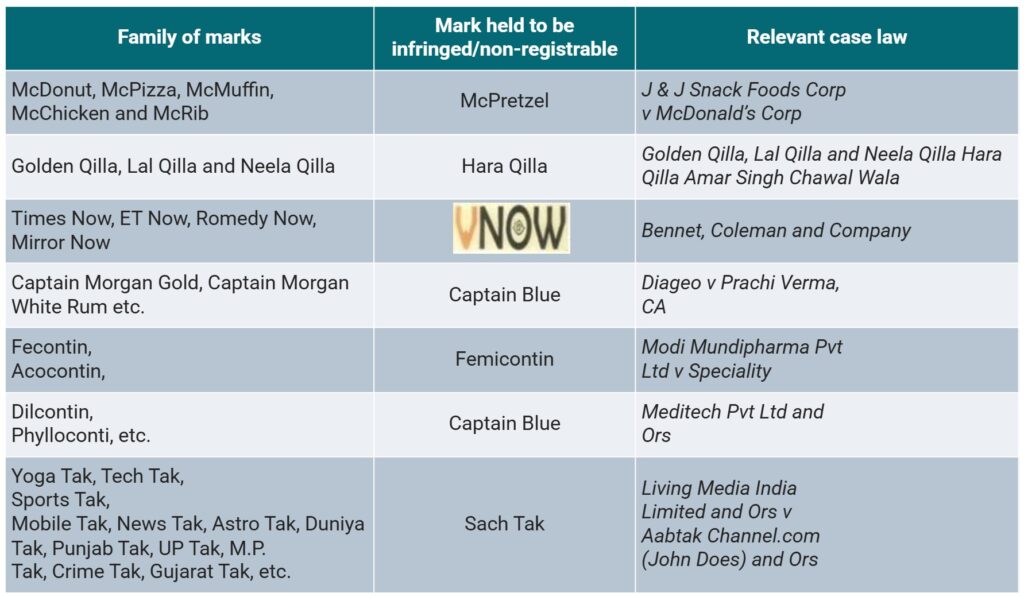
Family of marks doctrine in India
The family of marks doctrine, while not statutorily defined under Indian law, is a common law extension prohibiting the registration and use of marks or trade names that are likely to cause confusion.
The family of marks doctrine has become a viable option for companies and brand owners. It helps in establishing goodwill regarding a new mark which is adopted with the same prominent element due to the already established goodwill of the pre-existing marks of the family.
It may not be easy to adopt a new mark, as it may be in conflict with the various marks already existing. This doctrine also helps in avoiding that situation.
 etc. whilst wrongfully claiming to be part of our firm and making false claims and allegations.