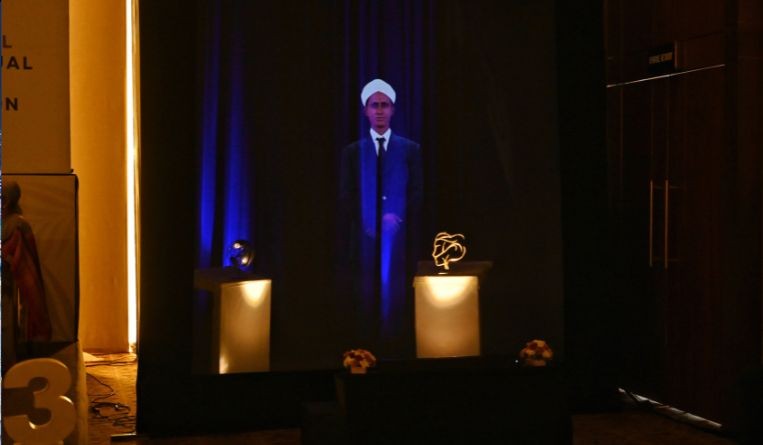
Among numerous attendants at the Global Intellectual Property Convention (GIPC), which took place in Goa on February 18 and 19, 2023, there was one exceptional guest – the late Chandrasekhara Venkata Raman, who was presented as a 3D hologram during the convention. Thanks to advanced technologies including AI, face superimposition, speech synthesis, deep learning techniques etc., it is now possible to speak and interact with India’s first Nobel laureate.
The 3D hologram was a prototype launched by the Noida-based IP law firm Anand and Anand, which will celebrate its 100th anniversary in August this year. Pravin Anand, managing partner at Anand and Anand, shared that the project aims “to make science attractive to youngsters by making it fun and giving it a cool appearance”. He said: “The present generation is different from previous ones in one big way. Science and scientists aren’t celebrated in the same way that they once were. Sportspersons, actors, influencers, and big-tech businesses are celebrated. Hard science has taken a backseat. This 3D hologram project was conceptualized to spread the message of the importance of science amongst children.”
Assisted by his colleagues Vaishali Mittal and Siddhant Chamola, Anand launched the project out of his love for hard sciences and the scientific approach to problem-solving as an IP lawyer. “This is more of a personal project, and is our way of giving back to society,” he said. “Having said that, everything which contains technology is relevant to the IP industry. We wanted to honour legends of the past, using the technology of the here and now, which is expected to make big changes to the world as we know it. This hologram uses new technology such as AI, voice recognition, and face morphing to create an interactive, and almost life-like persona of Sir CV Raman.”
Anand said that the hologram is currently trained on a database of exhaustive questions. “The prototype, in its current avatar, has over 100 detailed answers that I have authored and curated,” he said. “When a question is asked, the AI and voice-recognition technology enables the hologram to pick up cues, keywords, and even emotional undertones in a human being’s speech, so that it can respond with an answer which is most contextual to the question.”
After the presentation at GIPC, the hologram of Raman will be made available to other institutions, with details to be decided in the next few weeks. “We are currently working with our partners – Opezee, a Bengaluru-based startup which specializes in such holograms – on scaling up this hologram,” said Anand. “We are also grateful to Mr. Vivek Radhakrishnan, the grandson of Sir CV Raman, for giving us his consent to make this project a reality.”

Born in 1888, Raman was an Indian physicist known for his work in light scattering. He discovered that when light traverses a transparent material, the deflected light changes its wavelength and frequency. This effect was subsequently named after him as the Raman effect, for which he was awarded the 1930 Nobel Prize in Physics, making him the first Asian to receive a Nobel Prize in any branch of science. The date on which the Raman effect was discovered, February 28, is celebrated annually by the Government of India as the National Science Day.
In addition to Raman’s hologram, Anand also plans to extend the project to other eminent figures. “Currently, we are working on adding about five to six scientists to this project from within and beyond India. We will reveal the names in the coming weeks.” He shared the eventual goal of establishing a virtual museum of 3D holograms of scientists from India and worldwide. “One day, we may be able to scale it to make this an international, borderless museum, with different countries adding celebrated and lesser-known scientists.”
Click here for the video from the hologram launch
 etc. whilst wrongfully claiming to be part of our firm and making false claims and allegations.